
The large flange concrete screw anchor for mounting hurricane shutter headers and tracks. Drill, drive, done — no shield, no separate anchor body to set first.
Why the large flange matters
The 5/8" flange head is the point of this anchor. A standard screw head concentrates load on a small ring of the track flange; a large flange spreads it. That raises pullover resistance — the track cannot tear over the head under wind load — and it reduces cracking during installation. If you have ever had a header pull over a fastener while the fastener itself stayed put in the wall, this is the anchor that prevents it.
White finish, so fasteners blend against stucco and trim instead of dotting the wall.
Code approvals
Covered by Florida Product Approval FL39170, under the Florida Building Code. The drawing's title block states the anchors are valid for use inside and outside the HVHZ — limitations apply, see the approval.
That distinction matters more than it sounds. Several widely used concrete screw anchors are excluded from High Velocity Hurricane Zone use by their own evaluation reports, which puts them off-limits for Miami-Dade and Broward work no matter how carefully they are installed.
The Solid Set line also holds Miami-Dade County Product Approval, Florida Building Code Approval, California Building Code Approval and AC257 treated lumber certification. Core anchors in the line carry ICC-ES evaluation: concrete ESR-4340, masonry ESR-4339, chemically treated wood ESR-4357.
Minimum embedment and edge distance
| Substrate | Embedment | Min. spacing |
|---|---|---|
| 3,000 psi concrete | 1-3/8" or 1-3/4" | 3" to 6" |
| Grout-filled block | 1-3/4" | 3" |
| Hollow block | 1-1/4" | 3" to 6" |
| Wood (G = 0.55 or 0.42) | 1-1/2" | 3" |
Minimum edge distance in wood is 3/4". In concrete and block it varies with embedment and spacing — the approval tabulates allowable tension and shear at each edge distance, so read the row matching your condition rather than a single number.
Embedment excludes stucco and wall finish. Measure into sound structure, not from the face of the wall. Anchoring into a finish coat like stucco is not considered.
Wood density note
This anchor is approved into wood down to a specific gravity of G = 0.42, which covers spruce-pine-fir and most common framing lumber. Some hurricane anchors require G = 0.54, which in practice means Southern Pine or denser. If you are fastening to wood and do not know the species, that single number decides whether an anchor is approved at all.
Specs
- 1/4" diameter, 5/8" flange head
- Four lengths: 1-3/4", 2-1/4", 2-3/4" and 3-1/4"
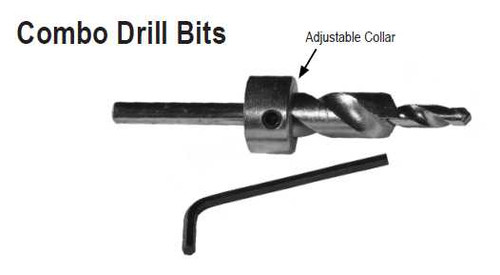
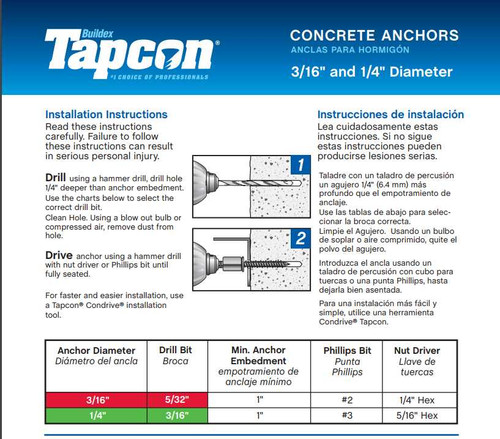
- Pre-drill with a 3/16" ANSI masonry bit, 1/4" deeper than the screw length
- White exterior finish
- Bags of 25, 50 or 100
Before you drill
Anchors must not be installed in cracked concrete, or in concrete that has not yet reached its design strength. Clear the hole of dust before setting. Confirm the required design pressure for your openings with your local building department.
You will also need
- Headers and Tracks — what this anchor mounts
- 3/16" Masonry Drill Bits — for the pilot hole